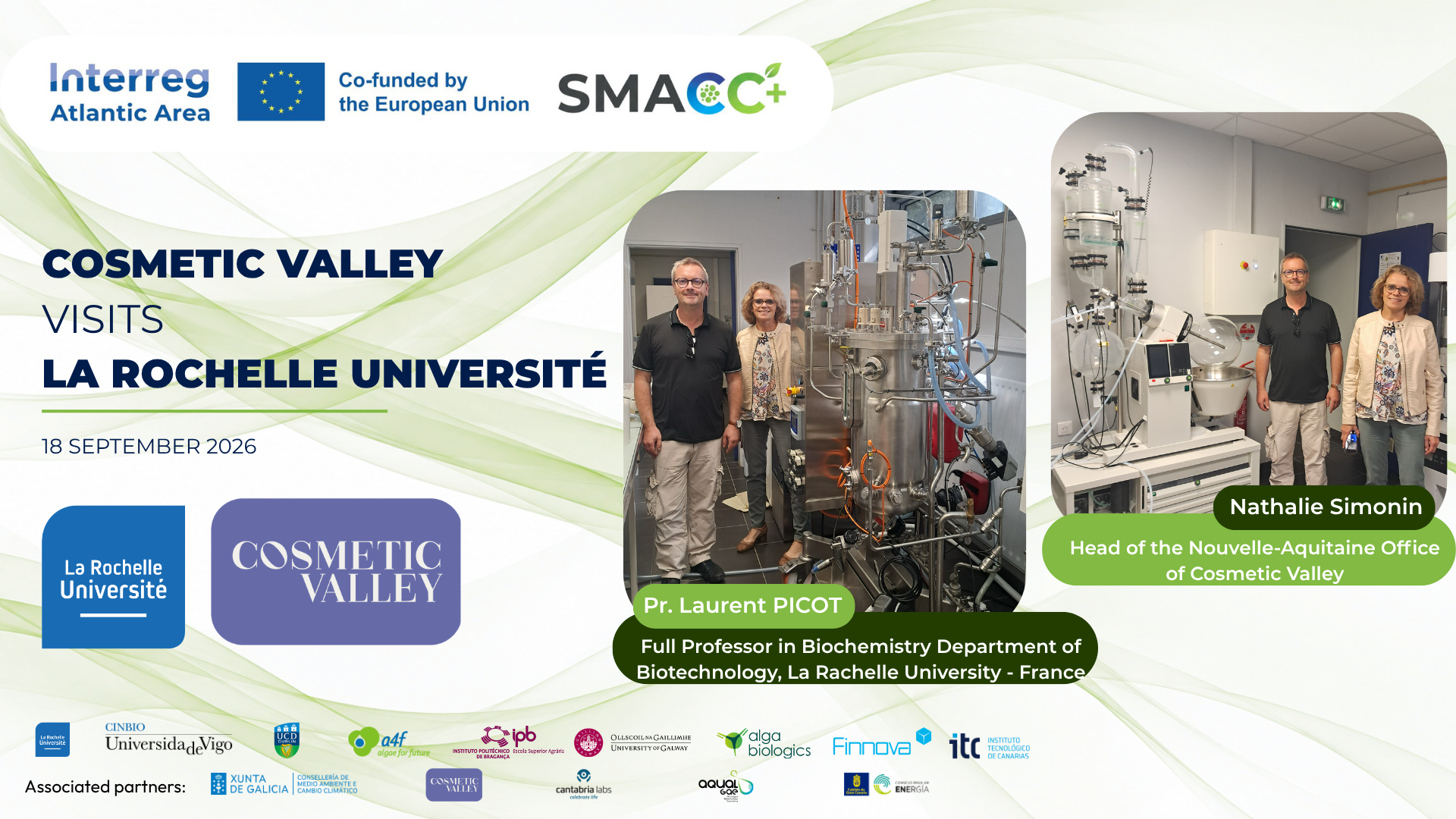
-Nathalie Simonin, Head of the Cosmetic Valley Nouvelle-Aquitaine Office, visited La Rochelle University to explore synergies between microalgae biotechnology and the cosmetics sector
-The visit included the BioAqtiv biotechnology innovation laboratory and the LIENSs research unit, with discussions focused on the development and valorisation of microalgae-derived bioactive ingredients for dermocosmetic applications
-The meeting reinforced cooperation between research, innovation and industry and supported SMACC+ objectives related to technology transfer, SME uptake and the international visibility of the Atlantic blue bioeconomy
La Rochelle, France, 18 September 2026
On 18 September 2026, Nathalie Simonin, Head of the Nouvelle-Aquitaine Office of Cosmetic Valley, visited La Rochelle University in the framework of the Interreg Atlantic Area SMACC+ project.
Cosmetic Valley is an associated partner of SMACC+, contributing its expertise and extensive network within the French cosmetics industry. Nathalie Simonin coordinates Cosmetic Valley activities in Nouvelle-Aquitaine and contributes to connecting companies, public research laboratories, training organisations and other stakeholders involved in the perfume and cosmetics value chain.
The visit provided an opportunity to present the research and technological capabilities available at La Rochelle University and to discuss how they could be mobilised to accelerate the development of innovative and sustainable ingredients derived from microalgae and cyanobacteria for dermocosmetic applications.
Connecting microalgae biotechnology with the cosmetics value chain
The programme included a visit to BioAqtiv, La Rochelle University’s biotechnology innovation laboratory, and to the LIENSs – Littoral Environnement et Sociétés research unit (UMR CNRS 7266).
BioAqtiv acts as a bridge between academic research and industrial innovation and supports the development of bio-based products from plant, marine and microbial resources. Its expertise covers biomass processing, extraction and purification of biomolecules, structural and functional characterisation, assessment of biological properties and formulation, providing a direct pathway from laboratory research towards pilot-scale development and industrial transfer.
The visit also highlighted the scientific expertise of LIENSs in chemistry and biotechnology applied to marine bioresources. LIENSs is a joint research unit of La Rochelle University and CNRS whose interdisciplinary research includes the sustainable use and valorisation of coastal and marine resources.
Discussions focused particularly on the potential of microalgae-derived extracts, pigments and other bioactive compounds as future ingredients for dermocosmetic applications and on the technological steps required to move from biological resources to characterised, reproducible and potentially marketable ingredients.
Strengthening cooperation between research and industry
A central objective of the meeting was to explore how the complementary expertise of La Rochelle University, BioAqtiv, LIENSs and Cosmetic Valley can help strengthen interactions between the microalgae and cosmetics sectors.
The discussions highlighted opportunities to connect research results generated within SMACC+ with the needs of cosmetics companies, particularly SMEs seeking new natural, sustainable and scientifically validated ingredients.
Potential areas of cooperation include the identification of promising bioactive extracts, biological validation, optimisation of extraction and purification processes, formulation, scale-up and the establishment of new contacts between researchers and industrial stakeholders.
This approach closely reflects the objectives of SMACC+, which include transferring knowledge from research to industry, fostering collaboration between researchers and companies, and accelerating the adoption of sustainable microalgae-based biotechnological solutions. Technology transfer and SME uptake are central pillars of the project.
Building a stronger Atlantic innovation ecosystem
Beyond individual research projects, the visit also provided an opportunity to discuss the territorial dimension of innovation.
By linking the microalgae and cyanobacteria sector with the dermocosmetics ecosystem, SMACC+ aims to encourage the emergence of new collaborations and value chains rooted in Atlantic territories while providing companies with access to national and international networks.
The involvement of Cosmetic Valley is particularly valuable in this context, helping connect scientific expertise with companies, innovation stakeholders and market needs.
Strengthening these links can contribute to the local anchoring of innovative companies, while increasing their visibility at French, European and international levels. It also supports the attractiveness of Nouvelle-Aquitaine and the wider European Atlantic Area as a territory for blue biotechnology, sustainable cosmetics and bio-based innovation.
The visit therefore represents another step towards creating an effective interface between microalgae production, biotechnology, dermocosmetic research and industrial development, helping transform scientific knowledge into concrete innovation opportunities.
From research to market-oriented innovation
The exchanges in La Rochelle illustrated the importance of developing a continuous pathway from the discovery of marine bioactive compounds to their industrial application.
SMACC+ specifically addresses this challenge by combining sustainable cultivation, extraction and purification, bioactive characterisation, formulation, sustainability assessment and technology transfer. The project seeks to ensure that promising microalgae and cyanobacteria resources can move beyond laboratory-scale research towards scalable and market-oriented solutions.
The visit of Cosmetic Valley to La Rochelle University reinforces this ambition by bringing together complementary expertise in scientific research, biotechnology, technology transfer, industrial networking and cosmetics innovation.
About SMACC+
SMACC+ – Sustainable Microalgae and Cyanobacteria-Based Bioactive Compounds for Cosmeceuticals and Nutraceuticals is a European cooperation project co-funded by the European Regional Development Fund through the Interreg Atlantic Area Programme.
The project brings together nine core partners and five associated partners from Atlantic European regions, including La Rochelle University and Cosmetic Valley, with the objective of accelerating sustainable innovation based on microalgae and cyanobacteria through applied research, technology transfer and transnational cooperation.
SMACC+ contributes to the development of a more resilient, circular and competitive Atlantic blue bioeconomy by connecting scientific expertise with industrial needs and supporting the development of sustainable high-value ingredients for cosmeceutical and nutraceutical applications.