The project was represented by La Rochelle Université and CINBIO during one of Europe’s key events for young professionals in the algae sector
SMACC+ showcased its commitment to sustainable innovation through microalgae- and cyanobacteria-based solutions
The symposium promoted collaboration, networking and knowledge exchange between academia and industry in the microalgae and seaweed sectors
Wageningen, Netherlands, 27th May 2026
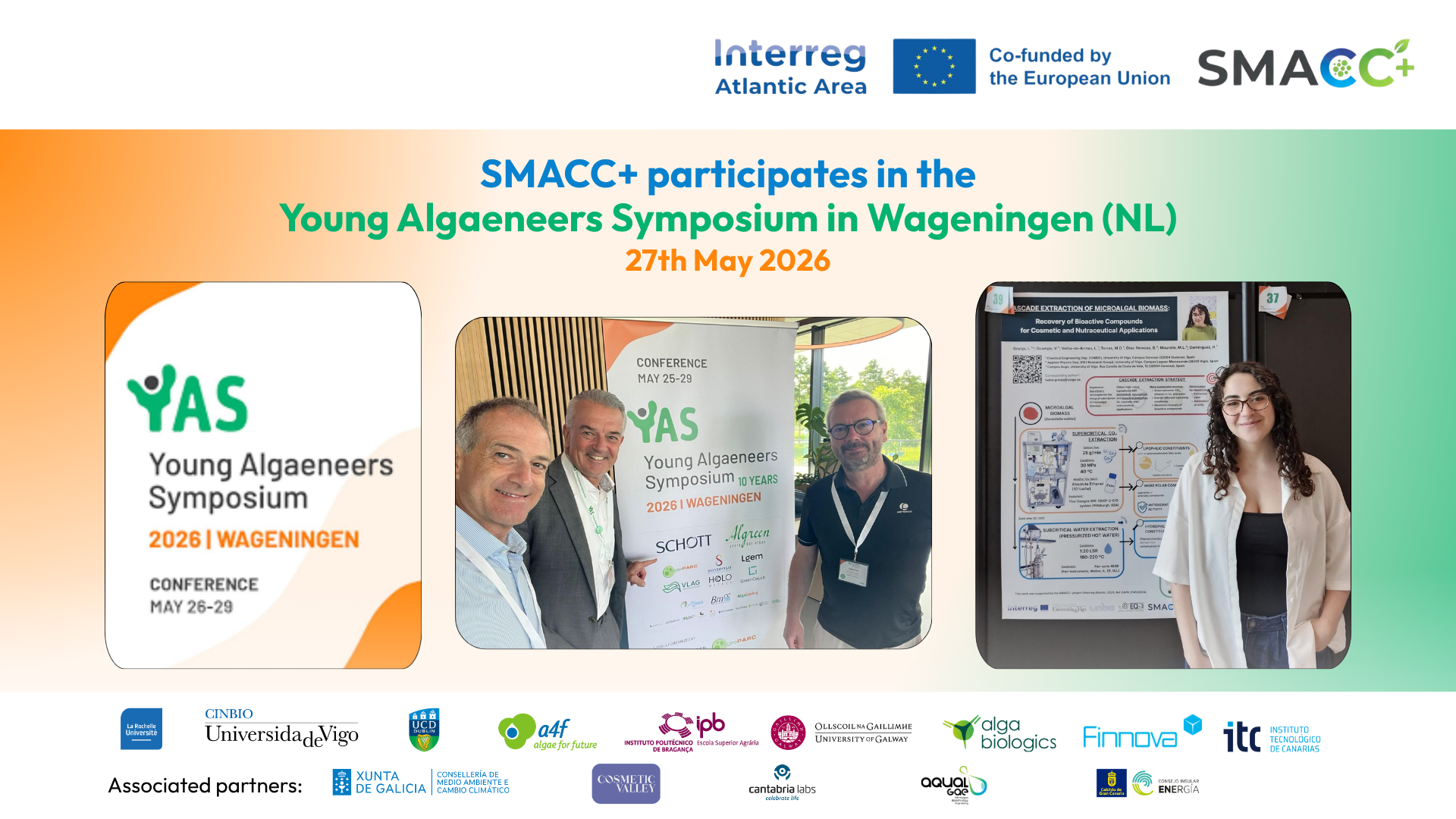
On May 27th, 2026, the Interreg Atlantic SMACC+ project was presented at the Young Algaeneers Symposium (YAS) 2026, held in Wageningen, Netherlands.
The Young Algaeneers Symposium is an international conference created by and for young scientists and entrepreneurs working in the microalgae and seaweed sectors. Supported by the European Algae Biomass Association (EABA), the event aims to foster innovation, inclusion, international collaboration and professional development within the algae community.
SMACC+ was represented by Prof. Laurent Picot from La Rochelle Université and Luana Granja Fernández from CINBIO. Their participation highlighted the role of SMACC+ in advancing sustainable innovation through the development of bioactive compounds derived from microalgae and cyanobacteria for applications in cosmeceuticals and nutraceuticals.
Young Algaeneers Symposium (YAS) 2026: a space for networking, inclusion and international collaboration
The conference provided an excellent opportunity for SMACC+ partners to connect with fellow researchers, entrepreneurs and industry representatives, while exchanging knowledge on current trends, technological advances and future challenges in algal research and innovation.
YAS 2026 brought together young researchers, start-ups, companies and academic institutions committed to advancing sustainable solutions based on algae and marine biotechnology. Through presentations, workshops and networking activities, the event encouraged interdisciplinary collaboration and empowered the next generation of scientists and innovators in the sector.
In this context, SMACC+ reinforced its commitment to participating in initiatives that promote innovation, collaboration, empowerment, inclusion and internationality within the sustainable microalgae- and cyanobacteria-based solutions sector.
SMACC+ participation in this event was fully aligned with the project’s objective of promoting sustainable innovation based on microalgae- and cyanobacteria-derived bioactive compounds for cosmeceutical and nutraceutical applications. The symposium also contributed to the dissemination of the SMACC+ vision among early-career scientists, start-ups, academic institutions and industrial actors active in the algae sector.
Presentation of SMACC+ through an innovation case study
During the symposium, SMACC+ was presented through an interactive mentoring case study led by Prof. Laurent Picot. The case study focused on the development of a naturally coloured and functionalized vegetable oil enriched with microalgae-derived pigments and lipid bioactives. The concept was not presented only as a final consumer oil product, but as a versatile functional ingredient platform suitable for incorporation into several applications, including functional vegan milk-like beverages, oil-in-water emulsions, nutraceutical drinks, food supplements and other clean-label functional food formulations.
The case study invited young participants to address a realistic innovation challenge: how can microalgae-derived pigments and bioactive compounds be incorporated into a vegetable oil matrix to create a stable, safe, regulatory-compliant, sustainable and economically viable functional ingredient for the European nutraceutical and functional food markets? The exercise required students to combine scientific reasoning, formulation strategy, regulatory awareness, sustainability assessment, scale-up analysis and business model development.
Luana Granja Fernández, student from CINBIO group, also attended the conference to present some results of the projects, learn and participate in the course.
Scientific and formulation dimensions
The mentoring activity encouraged participants to consider the technical feasibility of developing a functionalized oil-based ingredient enriched with microalgal compounds. Particular attention was given to the selection of lipophilic bioactives, their compatibility with vegetable oil matrices, oxidative stability, pigment degradation, sensory acceptability, batch-to-batch variability and formulation robustness.
Using the Oleo Health concept as a practical example, participants explored the formulation of a vegan, milk-like oil-in-water nanoemulsion designed to respond to several documented nutritional challenges through a single daily food-format product. The proposed ingredient set included microalgae-derived astaxanthin, algae-derived DHA oil, vitamin D3 oil, a European vegetable oil phase such as colza oil, pea protein and sunflower lecithin. The oil phase was considered central to the concept, since it enabled the incorporation and stabilization of lipophilic bioactives before emulsification.
The case study also introduced high-pressure homogenisation as a relevant industrial process for producing oil-in-water emulsions and plant-based beverage-type formulations. Participants were asked to consider technical constraints associated with droplet-size consistency, bioactive retention, oxidative stability and batch reproducibility when moving from formulation development to pilot-scale or industrial production.
Regulatory and labelling considerations
A significant part of the mentoring discussion was dedicated to regulatory and labelling strategy. Students were encouraged to distinguish between scientific functionality, legally authorised claims and future product-development opportunities. The discussion included authorised claims linked to vitamin D, DHA/EPA and DHA, while also noting that lutein does not currently have an EFSA-approved health claim.
This regulatory dimension was important because it demonstrated that innovation in functional nutrition cannot be based only on scientific potential. It must also integrate what can realistically be communicated, labelled and commercialized in Europe. The students were therefore invited to design a product pathway compatible with European food law and with credible B2B communication.
Industrial scale-up and business model
Beyond the formulation itself, the activity introduced participants to the industrial and economic dimensions of algae-based innovation. Students were asked to consider CAPEX and OPEX reasoning, pilot-scale production scenarios, contract manufacturing options, quality-control requirements, packaging costs, ingredient cost drivers and B2B pricing logic.
The enriched oil or emulsion platform was positioned as a functional B2B ingredient rather than as a commodity plant-based beverage competing only on price. Potential application areas discussed included functional vegan beverages, clinical nutrition, pharmacy-oriented products, healthy ageing nutrition and premium nutraceutical formulations.
A central point of discussion was the identification of the main scale-up bottleneck. In the case study, this bottleneck was linked to the maintenance of emulsion stability and bioactive retention under industrial processing conditions, particularly during high-pressure homogenisation and transition toward pilot-scale production. Students were encouraged to identify whether the limiting factor was technological, economic or regulatory, and to propose a credible mitigation strategy.
Sustainability and life-cycle thinking
Sustainability was another central component of the case study. Participants were asked to consider the environmental implications of ingredient sourcing, cultivation, extraction, formulation, packaging and distribution. The use of algae-derived DHA was discussed as a vegan alternative to fish-derived omega-3 sources, while microalgae-derived astaxanthin was presented as a natural bioactive pigment suitable for clean-label innovation.
The need for a full life-cycle assessment was emphasized, together with the importance of defining a functional unit, system boundaries, cultivation and extraction impacts, biomass valorisation and packaging options. This approach helped students understand that sustainability claims must be supported by structured reasoning and, where possible, quantitative assessment.
Contribution to SMACC+ objectives
Through this mentoring activity, SMACC+ demonstrated how microalgae-derived bioactive compounds can be translated into realistic functional ingredient concepts when scientific innovation is combined with industrial feasibility, regulatory clarity, environmental responsibility and market-oriented thinking. The case study helped young researchers move beyond a laboratory-centred view of biotechnology and encouraged them to structure a complete innovation pathway, from biomass and bioactive compounds to formulation, scale-up, sustainability assessment and business strategy.
The participation of SMACC+ in the Young Algaeneers Symposium also contributed to the project’s broader dissemination and networking objectives. The event enabled direct exchanges with young researchers, entrepreneurs and stakeholders from the algae sector, while reinforcing the project’s commitment to innovation, collaboration, empowerment, inclusion and internationality.
By contributing to this event, SMACC+ strengthened its visibility within the European algae community and supported the development of the next generation of scientists and innovators working on sustainable microalgae-based solutions.
Conclusion
Overall, SMACC+ participation in the Young Algaeneers Symposium 2026 was highly relevant to the project’s objectives. The activity connected the scientific valorisation of microalgae-derived compounds with concrete challenges related to formulation, regulation, industrialisation, sustainability and market deployment. It illustrated the strategic role of SMACC+ in supporting the emergence of credible, sustainable and commercially relevant algae-based ingredients for future applications in functional foods, nutraceuticals and related bio-based sectors.
Interreg Atlantic project SMACC+
Co-funded by the Interreg Atlantic Area programme of the European Union, SMACC+ focuses on valorising microalgae and cyanobacteria biomass to obtain high added-value bioactive compounds for cosmeceuticals and nutraceuticals, promoting sustainability and a resilient and circular blue bioeconomy.
The project consortium is made up of 9 core partners: the Universidad de Vigo (project coordinator), La Rochelle Université, University College Dublin, Instituto Tecnológico de Canarias, A4F-Algae for Future, Instituto Politécnico de Bragança, University of Galway, Alga Biologics and Finnova Foundation. The project also has several associated partners: AQUALGAE, Cantabria Labs, Cosmetic Valley, Xunta de Galicia and Consejo Insular de la Energía de Gran Canaria. SMACC+ has a total budget of 2.803.068,07€.
Visit SMACC+ official website for more information: https://smaccplus.eu