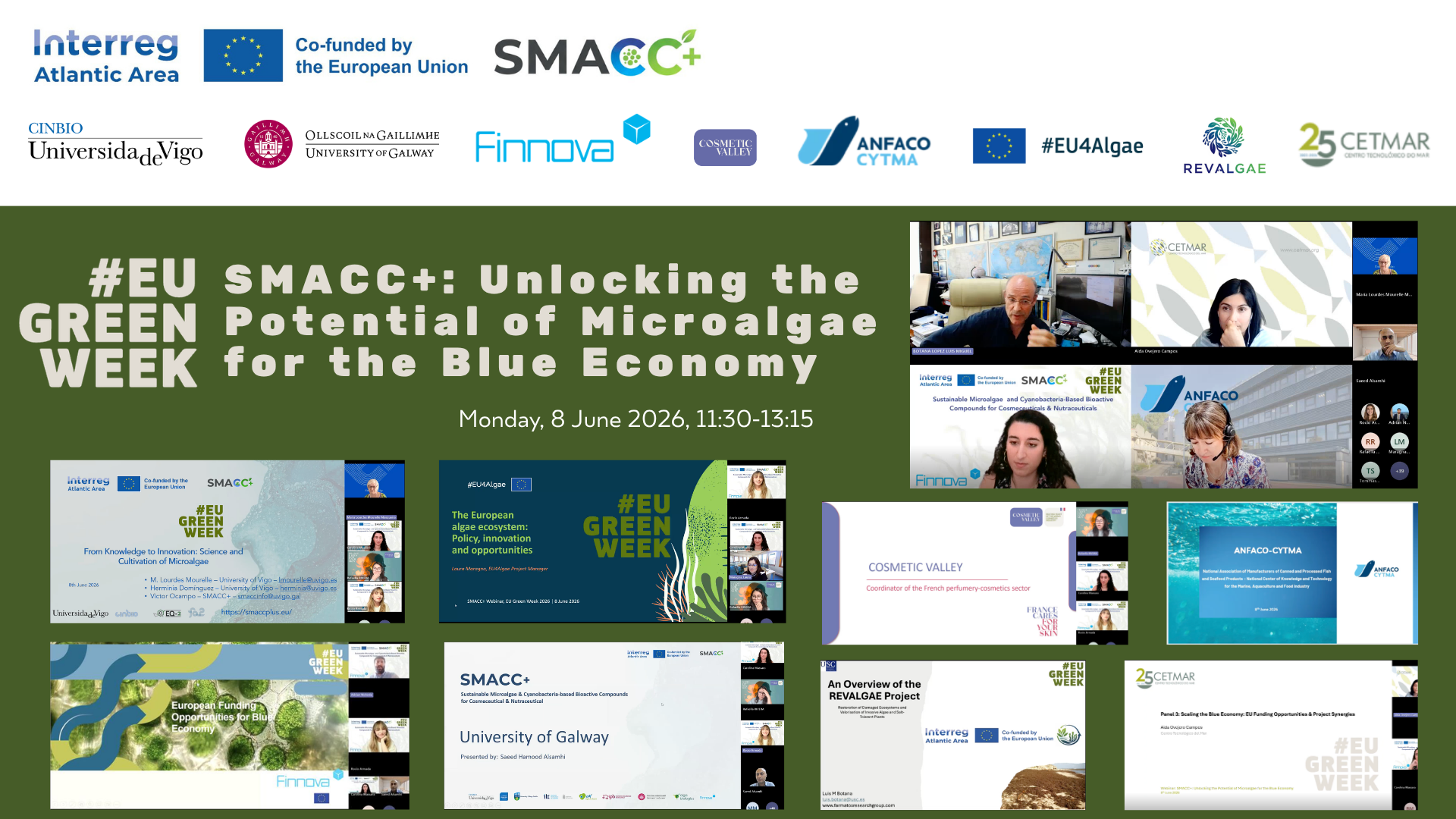
·The project brought together experts from nine European institutions on 8 June for a webinar on microalgae and sustainable marine innovation
·The session examined EU policy priorities, scientific and industrial applications of microalgae, and the challenges of scaling the Atlantic blue bioeconomy
Monday, 8 June, Brussels/Vigo.
The Interreg Atlantic Area project SMACC+, led by the Universidade de Vigo and with Finnova Foundation as a partner, held the webinar "SMACC+: Unlocking the Potential of Microalgae for the Blue Economy" on Monday, 8 June, as a partner event of EU Green Week 2026. The online session, moderated by Rocío Armada Gallego, Project Officer at Finnova Foundation, brought together researchers, industry representatives, and European project managers from Spain, France, Ireland, and Germany to explore how microalgae can support Europe's green and blue transition in sectors including health, cosmetics, and nutraceuticals.
The European algae ecosystem
Laura Maragna, EU4Algae Project Manager at EurA Innovation Ecosystems, delivered the opening intervention with an overview of the European policy landscape and funding ecosystem supporting the algae sector. She presented the key EU policy frameworks underpinning the sector's development, including the EU Algae Initiative (2022), which sets out 23 actions across research, market development, regulation and awareness. Moreover, the European Ocean Pact (2025), which recognises algae as a key enabler of the future blue bioeconomy. Laura also highlighted a significant milestone, the EU Member States Algae Declaration, signed by national authorities and announced at the 2nd EU Algae Awareness Summit in October 2025, which reflects growing political commitment to advancing the sector at national level.
On the funding side, the presentation illustrated that substantial public investment has been committed to the algae sector across the full value chain and TRL spectrum, through funding programmes such as Horizon Europe, CBE JU, the EIC and EMFAF, underlining the European Commission's clear signal of support. Upcoming calls with September deadlines from CBE JU and Horizon Europe Cluster 6 offer concrete near-term opportunities for the sector.
Central to the presentation was the role of EU4Algae as the primary coordination platform and interface with DG Mare and other Commission services. With over 1,250 members spanning industry, academia, farmers, investors and public authorities, EU4Algae connects the algae ecosystem through knowledge exchange, policy engagement, and targeted tools, including the Algae Farmers Toolkit, the Licensing Toolkit, the Algae Industry Roadmap, and the Algae4Schools education programme, serving as the bridge between sector stakeholders and EU institutions.
From science to industrial applications
Universidade de Vigo researcher M. Lourdes Mourelle, alongside Herminia Domínguez and Víctor Ocampo (SMACC+), presented the scientific foundations of microalgae and cyanobacteria, noting that of the more than 200,000 known species only a few have commercial exploitation and that each kilogram of biomass fixes approximately 1.83 kg of CO2. The presentation reviewed the most valuable compounds (PUFAs, carotenoids, polysaccharides, peptides, and vitamins) and their nutraceutical applications, from cardiovascular prevention to immune support, and cosmeceutical uses including photoprotection, hydration, and skin barrier repair, alongside cultivation methods in photobioreactors and raceway ponds and green extraction techniques using supercritical CO2 and ultrasound.
Rafaella Rivera, European Project Officer at Cosmetic Valley, brought the perspective of the French cosmetics industry, a sector spanning 6,300 companies with annual turnover of €71 billion and 226,000 jobs, and presented the "Innovating with Seaweed in Cosmetics" training programme, launched in September 2025 with CEVA, and the ACTT4COSMETICS European project, aimed at developing 14 innovative solutions at the intersection of cosmetics, blue biotechnology, and ecological transition. Saeed Alsamhi, Senior Research Fellow at the University of Galway, complemented this with Life Cycle Assessment frameworks and circular bioeconomy approaches applied to microalgae production, while Adrián Noheda, EU Project Manager at Finnova Foundation, provided practical guidance on the Interreg Atlantic Area, Horizon Europe, and the LIFE programme as available funding instruments, and outlined Finnova's role within the consortium.
Scaling the blue bioeconomy
The session closed with a roundtable moderated by Carolina Massara, EU Project Manager at Finnova Foundation. Aida Ovejero Campos, Fisheries Product Technology Specialist at the Centro Tecnológico del Mar (CETMAR), an institution with over 700 projects and 1,700 partners from 81 countries, outlined CETMAR's strategic role in the valorisation of marine resources and algae and its lines of work with Atlantic and international reach. Luis M. Botana, Full Professor of Pharmacology at the University of Santiago de Compostela and coordinator of the REVALGAE project, addressed the potential of the blue bioeconomy from a pharmacological research standpoint and identified concrete synergies with other ongoing European projects. María José Chapela, R&D Business Development Manager - KTO at ANFACO-CYTMA, offered the processing sector's perspective on the challenges of translating algae-based innovation into concrete industrial applications. All four panellists identified regulatory fragmentation, the gap between pilot and commercial scale, and the need for greater coordination among European projects as the sector's main obstacles ahead.
SMACC+ is co-funded by the Interreg Atlantic Area programme of the European Union, with a total budget of €2,803,068.07, and brings together nine partners: Universidade de Vigo (coordinator), La Rochelle Université, University College Dublin, Instituto Tecnológico de Canarias, A4F-Algae for Future, Instituto Politécnico de Bragança, University of Galway, Alga Biologics, and Finnova Foundation, along with associated partners including AQUALGAE, Cantabria Labs, Cosmetic Valley, Xunta de Galicia, and the Consejo Insular de la Energía de Gran Canaria.
More information: https://smaccplus.eu